
passing through, passing on.
grief is not linear, but it would be nice if it was.

“It’s all really vivid. Do you know what I mean?” I asked John through my Airpods on a crisp, perfect spring day in Central Park. I was here, and he was there, and there was Los Angeles. “Oh, I know. I know so well,” he said. “Time stops for a moment and you remember just how bright and how full of life everything is when we’re here. Sometimes death reminds you of how alive everything around you is.” I stared at the tulips, nearly past their prime this season, still screaming in bright pink hues, shaking me by the shoulders: alive, we’re alive! “She had pink tulips on her bedside when I saw her last,” I stated. “They were the most beautiful shade of pink.” I could hear John nodding over the phone. I watched as the colors danced with such vibrancy; I couldn’t break line of sight.
My grandmother passed on a few weeks ago. And grief is a funny, temperamental thing. Because I’ve waited so long to write this, I waited until I thought I had processed it all, and writing that sentence just broke me in half yet again. Her passing was unlike the other deaths I had experienced in my family; hers was one we had time to prepare for. Up until she left us, I had been marred by traumatic phone calls and unexpected goodbyes that would bring me to my knees with my heart in my hands. But in late April, my parents called me to tell me that she was not doing well. They shared it wouldn’t be immediate, her leaving us, but it was coming. I hung up shortly after the news, standing on a street corner in Denver, Colorado with makeup on my cheeks from the night before. It was windy, and wind is always harsher when you feel the most raw. It sent a chill down my spine that I didn’t shake for the weeks to come.
I returned from my trip, each day feeling heavy; would today be the day? I had my Dad give me updates morning and night. I checked in on him every day. This was his mother, after all. The woman who raised him, who loved him, who loves him. For my entire life there wasn’t a Sunday he didn’t spend with his parents, and eventually just my grandmother. I would join for those trips when time allowed, and we’d sit in each other’s company and enjoy Barry’s Irish tea and laugh at my Dad and the jokes he would make so both of us lit up. My grandmother was quiet, but when she laughed, the whole world laughed with her.
After a week of waiting, dreading, sulking, I finally decided to go see her. Why I didn’t rush home sooner is beyond me; I think there’s always a part of us that assumes, or hopes, there will be more time. It’s denial, really. That there isn’t more time, and we must act fast, because every single moment together will mean more than the ones before. I visited her on a rainy Sunday morning. Her home looked the same and familiar voices chatted in various rooms; my aunts were here, and one uncle. I entered the room she was in behind my father, and her eyes lit up. I sat with her for the next few hours. We held each other's hands while she told me about her wedding day, showing me her album. She pointed out who was there, one by one: her mother, her siblings, my grandfather, his siblings, her friends, the priest. At one point, she just whispered, perhaps to me, but maybe mostly to herself: “They’re all gone.”
It dawned on me that, instead of dreading her passing, she was maybe, just maybe, ready. How brave it is to accept death, and not as a burden, but a relief from the heaviness of this life. And what a life she had lived, well into her nineties! It is a privilege to pass on from old age, one I only hope I get to experience. I drove back to my parents’ house with my Dad that afternoon and as we talked about my visit with her, and how much it delighted her, he closed with, “She’s just very tired, isn’t she?” Yes, she was. And I don’t blame her.
She passed on a week later. I like saying “passed on” instead of “passed away” because it makes me feel better, like, she’s somewhere else, and not just put away in some grave. We all have beliefs of what will happen to us when we die. But it’s not really about us, since once it happens, it happens; we don’t get a say in it. It’s really about our loved ones who go before us. We want to make sure they’re okay. We want to make sure that they left this world for something better. We want to make sure there’s some way they’ll still be with us. Maybe it’s through little signs that remind us of them. Or it’s in dreams, vividly embracing only to have them torn from our embrace. Or finding ways that we see parts of them in ourselves.
I had been struggling with the concept of death well before my grandmother passed on. I didn’t want to admit that to most people, as I’m healthy, and live a life that I am luckily obsessed with filled with incredible people. But for a little under a year now, I’ve been losing sleep over it, staring at my ceiling fan, agonizing over all that I have to do before I go. Treating life like it’s a checklist, making sure I do all of these things to make myself proud. Almost as if I can choose when I’m ready to leave; I’ve already learned that we do not get a choice in that.
When I sat with my grandmother for the last time, I got to ask her if she was happy with all of it, this life. She took in a long breath, closed her eyes, and exhaled with a big grin: “Oh, yes.” I didn’t answer right away as I started to get emotional. This is when I knew; she was going to leave us soon. She then leaned in and squeezed my hands, for the final time. “Keep doing what makes you happy.”
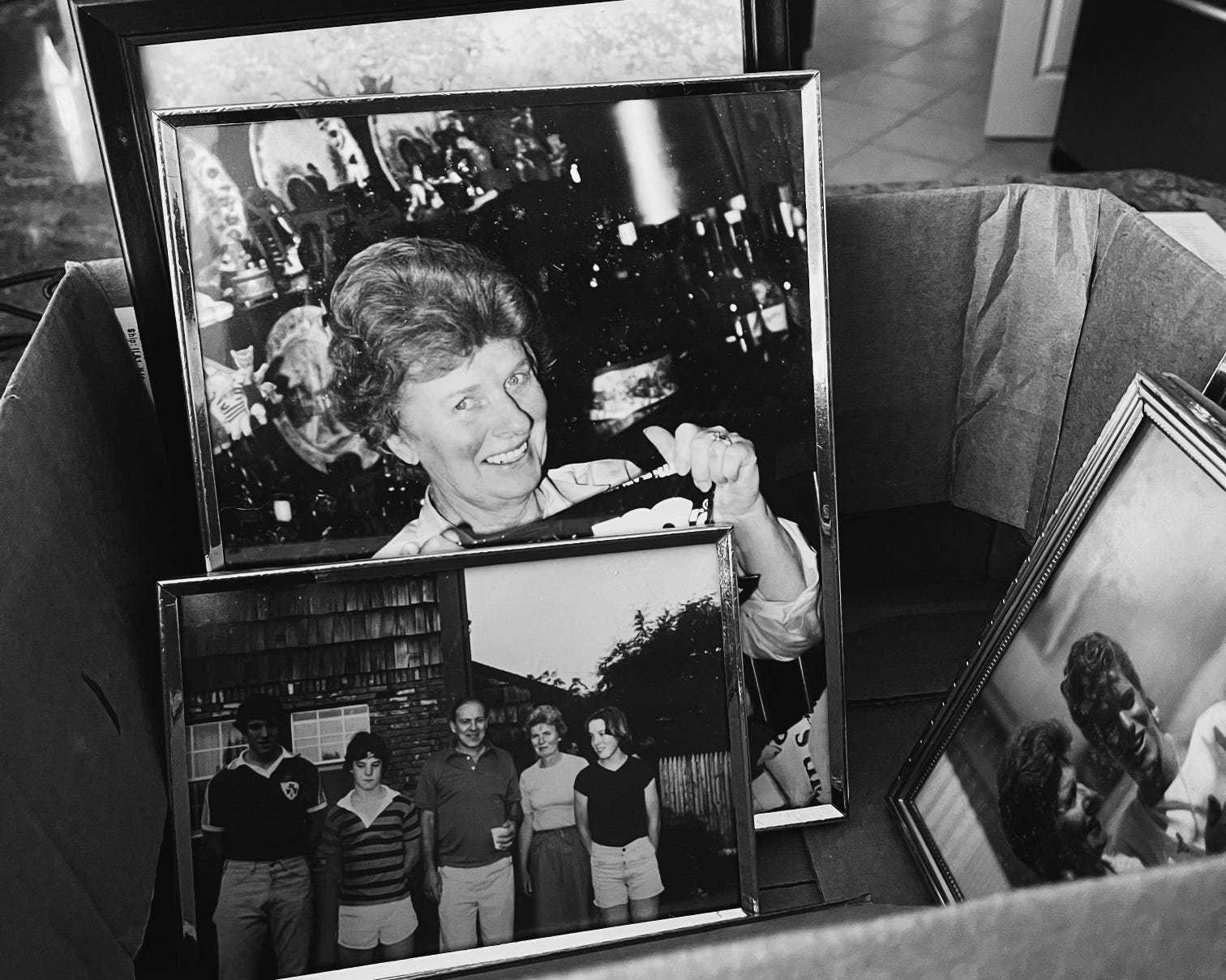
A week later was her funeral service. My family gathered at the funeral home for a private viewing before mass. I looked around at the plethora of photos strewn across the room. There were ones of her as a child, in black and white film, with her siblings, all who had passed on before her. There were her wedding photos, the ones she showed me, where she and my grandfather looked like movie stars in New York City’s Central Park. There were ones of her and her kids through the years. Seeing my Dad as a little kid, standing by her side, ripped my heart open once again; see, even when you thought you’ve processed it, grief appears again. Seeing my Dad’s freckled face, not unlike mine or my brothers, grinning wide with my grandmother, who’s hair was fiery red, made me remember that somewhere in my Dad is a little boy who lost his Mom. That little boy was the same man who visited her every Sunday for tea, who did her taxes, and who took over yard work when my grandfather passed on. My heart later shattered into a million pieces again, when that same little boy played the bagpipes at his own mother’s funeral procession.
When I talked to John on the phone the day my grandmother passed on, we talked about how the death of a grandparent ignites a kind of grief bigger than just missing someone. It reminds us of the passage of time, and how, while we sometimes feel invincible in our twenties and even thirties, time is marching on. It is the only certain thing in this life. My grandmother’s death marked the end of a very big chapter in my life and a very, very big chapter in my Dad’s life. We sat in his car before we entered the funeral home, just us. He said, “I’m now the oldest generation in my family. There’s me and Mom, then you and your brothers, and eventually, your children. But there is no one before me anymore.” I looked at my Dad. He does not look old; he takes care of himself and I hope that I carry on those healthy habits. But I felt it, in his voice; the weight of time, and his realization that it will never stop moving forward. I realized, deep in my bones, the seriousness of my age. The precipice I was on. And in the midst of death, an alive, childlike humanness with my Dad that had not been breached until this very moment.
There are the parts of death that you, logically, can accept. They were in pain. They were struggling. They are at peace. They lived a good life. They still love you. And so on. But what I couldn’t bring myself to logically accept was how quick, though seemingly slow, it all happened. I fell to my knees to pay final respects to my grandmother. There she laid; in green cashmere and pearls, just as she always was. A week ago she was here. No, a day ago, she was here. Pressure formed behind my eyes and I cried hot, angry tears. How does a soul leave that quickly? She was here a day ago. And now she is not. I wanted to throw some sort of tantrum. Death really is that swift.
I wanted to know everything, especially the hard things. What are those final moments like? What does your soul feel before it moves on? What was her final thought before she left us? I leaned my head on the mahogany rail before her casket. Why is it that I won’t know these things until I go, and by then, it’s too late to tell anyone else? Why did I want to know these things? My grandmother always praised my curiosity and creativity, but this felt tortuous.
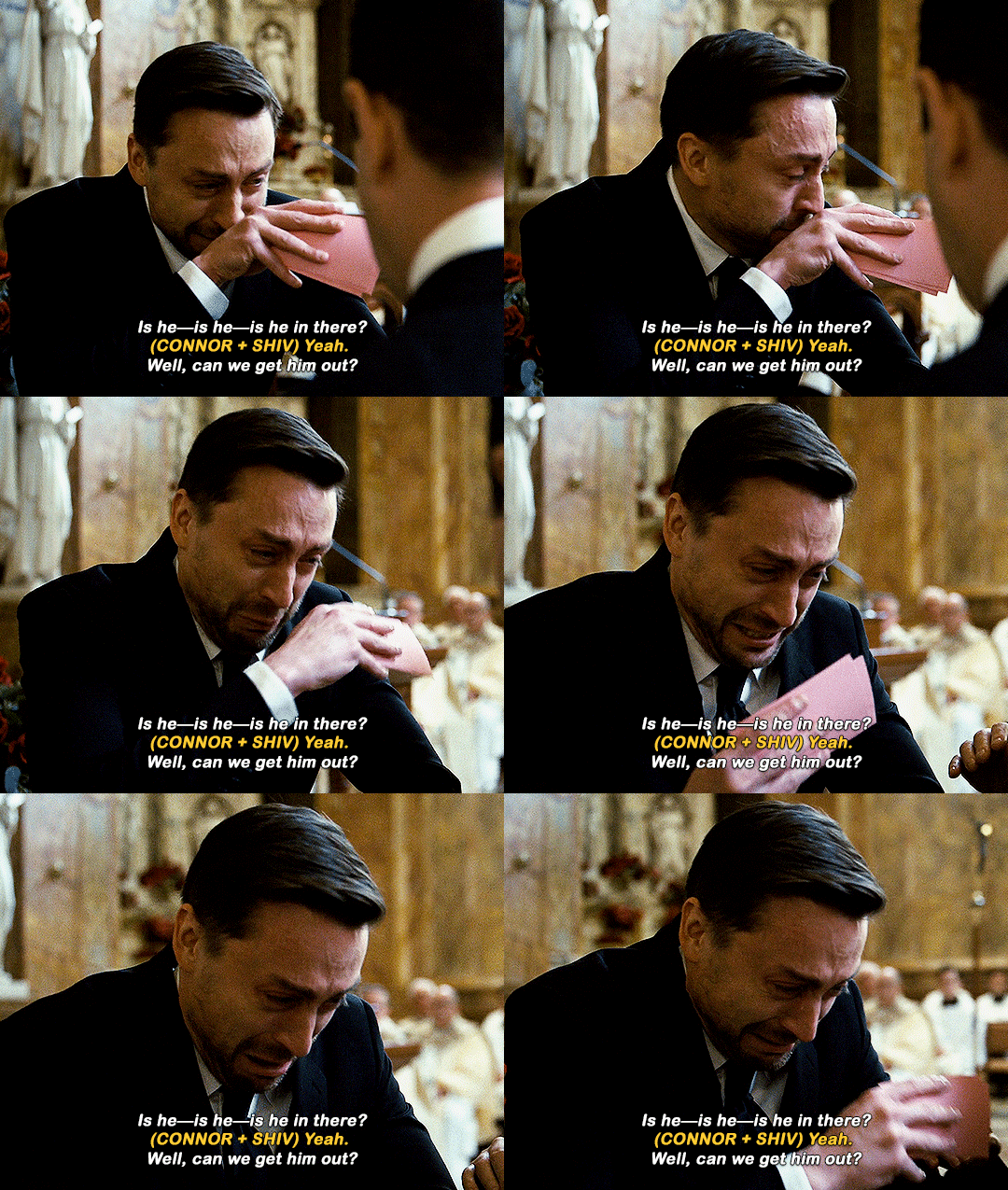
There’s a scene in the final season of Succession that haunts me, but displays the unique kind of desperation and disbelief that come with death. Note: Succession spoiler ahead. In the penultimate episode, Roman Roy is asked to give his father’s eulogy. His words fail him as he stands at the pulpit, staring down at his father’s casket. Roman breaks down in his siblings arms, sobbing, “Is he in there? Well, can we get him out?” This moment took my breath away, as a week earlier, I had felt the same exact range of emotions staring down at my grandmother. Was she in there? Can we get her out? Could we bring her back? I think that moment in the series displayed the denial in death that so many of us don’t know how to articulate. Someone was here, and now they are gone. It can’t be that simple; there has to be something we can do to reverse it. Right? I’m so glad the writers included this scene, as this stage of grief can be so hard to put a finger on if you haven’t felt it first hand (and, as an aside, Kieran Culkin better get an Emmy for that scene alone, if not the entire fourth season).
My grandmother’s funeral mass was beautiful, and I was reminded that death is in fact a mystery, and there’s some things that we don’t get to know until we experience them. This was a really annoying revelation for a person who likes to know everything. But it was and is true; we’ll all know, one day.
The day that my grandmother passed on, I took myself to Tavern On The Green in Central Park, where my grandparents got married. My grandmother grew up in Astoria, Queens, and went to Catholic school at the church closest to my apartment, something I only learned after telling her my address when I moved to the city a few years back (she first mentioned that she liked that I was close to Bloomingdales, for the record). I liked visiting these spots over the years to feel a closeness to her. Imagining her, as a young girl, praying before the altar in that Gothic church. Or her in her early twenties, buying one of her many cashmere sweaters or a pair of plaid pants at Bloomingdales on a cool fall day. The day she left us, I took myself to Tavern On The Green and had a glass of champagne, for her, and for my grandfather. I sat in the courtyard and raised a glass to them, reunited once again. I watched the string lights come on as the sky dimmed and I squinted my eyes; I could see them come to life from the photo albums my grandmother had just shown me. There they were, dancing and laughing and swaying to the music. “What A Wonderful World” by Louis Armstrong came on the speakers. That song came out well after my grandparents were married, but I couldn’t help but hope they were both dancing to it now, embracing at last. I felt a warmth settle on my shoulders; they were close.
My grandmother lived an incredibly beautiful life. It was hard, too, but that only accentuated its beauty. What I’ve finally admitted to myself is that through all of the grief and shock and anger I experienced in processing her death, the biggest feeling I have is that I will miss her. In the past ten or so years, I had gotten to know my grandmother on a much closer level. Mostly due to entering adulthood, I felt I could share many more things with her. She endlessly encouraged me in my dreams, especially in my bravery to live in different cities around the world. One of the last conversations I had with her was about living abroad in Europe, something I had felt compelled to do again in the coming years, but was nervous to do so, naturally. She shared that before she was married, she spent time in Germany, Italy, England and Ireland, traveling the countries, learning the cultures, living her life to its fullest. I never knew this about her; she had always stayed close to her home in New Jersey in her older age. Not that it meant she didn’t travel, but she didn’t always talk about it. Here I was, in her final few weeks on this earth, learning something new about my grandmother. As if she was waiting to reveal this part of herself to me at the right time, encouraging me to go, just as she did. I wanted to ask her so much more about what she saw and did, but time did not allow for that.
I will miss her, deeply, but especially in the times that I feel closest to her; standing in her childhood church on the Upper East Side, or at a pub in Galway she went to with my grandfather, or in the cashmere section at Bloomingdales. But I will relish in missing her, as I think that is the biggest compliment you can pay someone who has passed on. I’ve been told that she still will come to me in ways I don’t even know yet, and I look forward to continue learning from her in the years to come.
I struggled with if it was even appropriate to write this essay. It felt so personal, not just for me, but for my family, as she was not just in my life, but all of ours. It felt like an exploitation, even.
But then my Dad shared with me some poems my cousin Wesley had written. He had addressed my grandmother, noting that she was, “always asking what he was writing and creating these days.” I read his poems - beautiful and breathtaking, and one day I hope they’re shared with the world - but I was reminded that she was always interested in what all of her children and grandchildren were doing. My grandparents bought me some of my first paint sets when I was a child, and asked to see my artwork every time I visited them. As I grew to love fashion and writing, they would ask about what my newest project or focus was. So, all of this to say; this is a deeply personal essay, but it’s one I think my grandmother would have wanted me to share. Not because it is about her, but because she championed my passions more than even I did. As a creative, you always remember the first people who encouraged your talents. And I’ll carry that with me in all of my artistic pursuits.
May the road rise up to meet you. May the wind be always at your back. May the sun shine warm upon your face; the rains fall soft upon your fields and until we meet again, may God hold you in the palm of His hand.
For Mary Daly. I love you.
I'm so sorry for your loss of beautiful woman. That sorry is for all who knew her. Joan, this is important that you wrote it. You forgot the spoiler alert: box of kleenex need before reading. Tears are important. They carry so much grief and joy. They wash us anew. There are kinships that are so deep in us sometimes we don't realize until as you say...They leave us. I have no advice. It is your time to relish what she has given and to move to any city in the world. I sponsor that idea. Thank you for writing a truth so deep and beautiful . It reflects for me how beautiful you are in living this journey. I found it interesting as I read this piece to see how your past piece on friendship seems to link up to this one. Keep writing. It is solo and communal. Again, may she rest in peace...wherever.